

normal-online-PERSONAL DESIGN
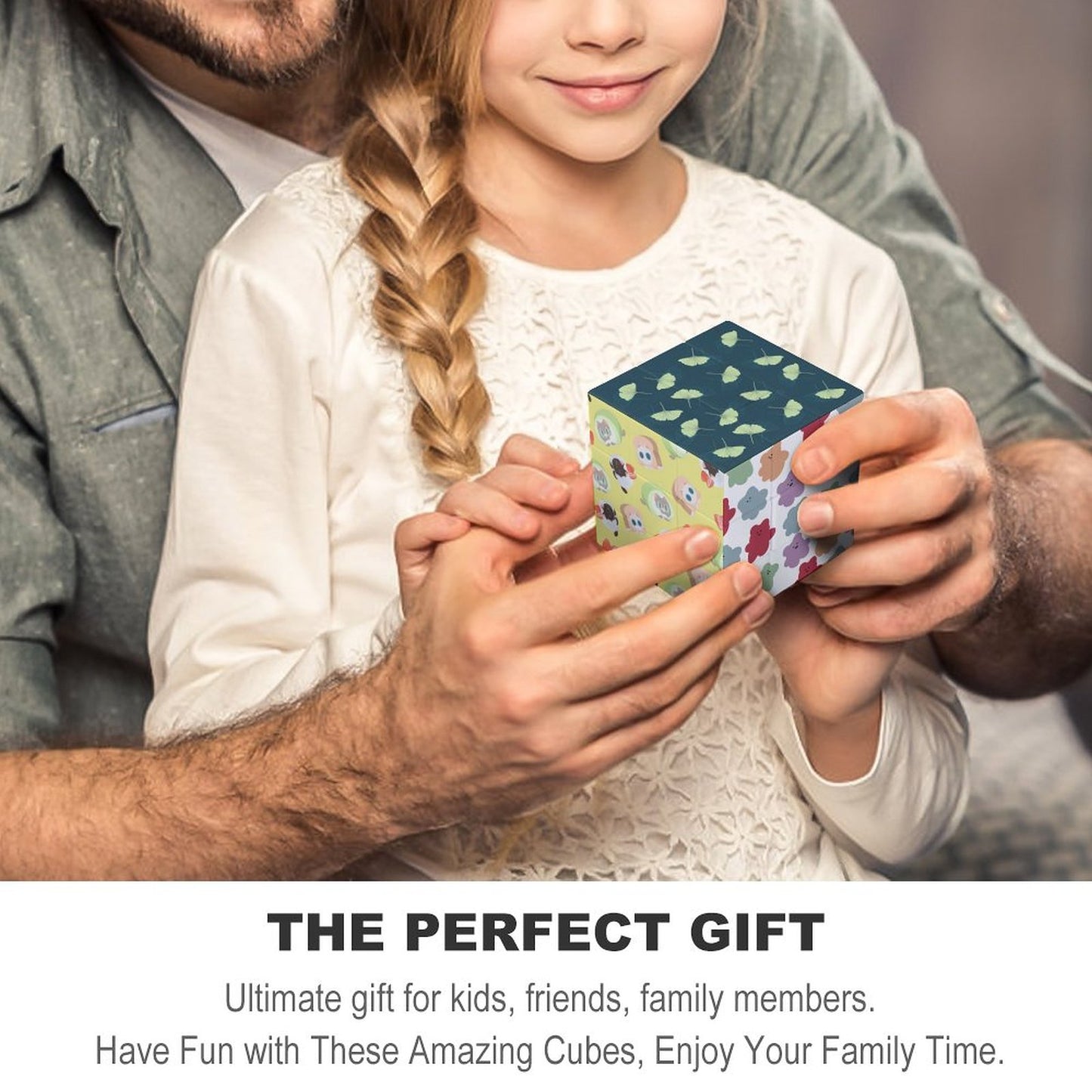
Custom Photo Magic Cube Personalized 3x3 Puzzle Brain Teaser | UV Print
Custom Photo Magic Cube Personalized 3x3 Puzzle Brain Teaser | UV Print
Couldn't load pickup availability
Custom Photo Magic Cube Personalized 3x3 Puzzle Brain Teaser – Where Memory Meets Mechanics
Twist the top layer and hear that satisfying *click*—not the cheap rattle of drugstore impulse buys, but the precision snap of engineered ABS thermoplastic where twenty-six individual pieces align through spring-loaded tension systems. This custom photo magic cube personalized 3x3 puzzle brain teaser replaces screen time with something your hands actually crave: the tactile reward of solving chaos into order, except the "order" is your golden retriever's face, your graduation photo, or that Icelandic sunset from last summer. UV-cured ink fuses directly into the polymer surface at molecular depth, so after three thousand solves and two years on your desk, the image stays photo-sharp while traditional sticker cubes have long since peeled into sad confetti.
Built for the parent waging war against iPad dependency who needs STEM education disguised as play, the gift-giver exhausted by generic sentiment who wants surprise wrapped in interaction, and the desk warrior whose anxiety lives in clenched jaw muscles that only repetitive hand motion seems to unlock. You've moved past toys that occupy without engaging. You need objects that bridge emotional memory with cognitive challenge—things that make people pause and say "Wait, is that *your* dog on a Rubik's cube?"
Why ABS Plastic Dominates Toy Engineering
Acrylonitrile-butadiene-styrene copolymer isn't just syllable soup—it's the material that survives childhood. Rockwell R-scale hardness hits 105-110, meaning this cube bounces off hardwood floors without chipping corners or stress-fracturing internal pivots. The styrene component provides rigidity for dimensional stability (pieces don't warp in summer heat or winter dryness). Butadiene rubber phase absorbs impact energy, which explains why speed-cubers trust ABS for competition gear that endures ten thousand solves per month. The acrylonitrile portion resists oils and moisture, so sweaty palms during timed challenges don't degrade grip texture or cause surface oxidation.
Chemical safety testing confirms food-contact-grade compliance—toddlers who inevitably mouth-test toys won't ingest plasticizers or heavy metal stabilizers. The dense, non-porous surface repels bacteria and wipes clean with damp microfiber cloths, unlike wood or foam puzzles that harbor grime in texture grooves.
UV Printing Versus The Sticker Apocalypse
Traditional photo cubes use adhesive-backed vinyl stickers—essentially temporary tattoos for plastic. Within weeks, thumbnail friction at corner edges causes curling. Sunlight exposure fades cyan and magenta layers unevenly, turning portraits into ghostly green-tinged distortions. Temperature fluctuations make adhesive brittle; one winter storage cycle and you're peeling flakes.
UV direct printing operates differently. Industrial print heads deposit photo-reactive ink droplets onto ABS at 1440dpi resolution—higher clarity than most phone screens. Ultraviolet LED arrays instantly polymerize the liquid ink into solid polymer film chemically bonded to the substrate. This creates a wear layer with pencil-hardness rating of 3H, surviving the same abrasion that would shred paper stickers in minutes. Cross-hatch adhesion tests (slicing a grid pattern then tape-pulling) show zero ink removal. Colors maintain 90%+ saturation after five years of indoor display because UV pigments resist photo-oxidation.
The hidden advantage: eliminating sticker thickness (typically 0.15mm) removes micro-ledges between cube faces. Air resistance during high-speed turns drops measurably—competitive speed-cubers obsess over these nanoscale aerodynamics. For casual users, it simply means smoother spins that don't catch or judder.
The 5.7cm Golden Ratio
This isn't arbitrary sizing—it's the World Cube Association competition standard, refined through decades of biomechanical testing. At 57 millimeters per edge, the cube fits adult palms for one-handed solving algorithms while remaining manageable for children's two-handed grip patterns. Thumb opposition mechanics work optimally when the pivot point sits 28.5mm from palm base—exactly half this cube's face diagonal.
Larger cubes (6cm+) require wrist rotation that fatigues forearm extensors during extended sessions. Smaller cubes (5cm) force fingertip-only manipulation that sacrifices leverage, slowing solve times and increasing drop risk. This Goldilocks dimension balances control with comfort across age ranges from six to sixty.
"We're not just manufacturing toys—we're engineering connection rituals. Every scrambled state is a challenge invitation. Every restored image is a dopamine micro-dose. This is analog interaction that doesn't track your data or need charging."
STEM Education Hiding in Plain Sight
Parents hunting alternatives to hypnotic screen glow can weaponize this cube as spatial reasoning bootcamp. Solving a 3x3 demands pattern recognition (identifying piece positions), algorithmic thinking (memorizing move sequences), and geometric visualization (predicting rotation outcomes). Neuroscience research confirms that manual puzzle-solving activates the parietal lobe's spatial processing networks—the same brain regions that excel at mathematics, engineering, and architecture.
Print family photos across the faces and suddenly homework breaks become "let's reconstruct Grandma's birthday picture" challenges. Kids develop grit through iteration (failed attempts teach adjustment), fine motor control through precise finger movements, and frustration tolerance through incremental progress. Unlike apps that hand-hold through levels, this cube offers pure meritocracy: you improve or you don't, with no pay-to-win shortcuts. The learning curve rewards persistence with measurable skill gains—average solve times drop from five minutes to under two minutes within three weeks of daily practice.
Maintenance That Preserves Perfection
- Surface care protocol – wipe with barely-damp microfiber cloths only; never use alcohol-based cleaners or disinfectant wipes which dissolve UV ink's protective topcoat and cause image fogging
- Tension adjustment – if cube feels too loose (pieces pop out during aggressive turns) or too tight (rotation requires excess force), gently turn center caps to access internal screws; quarter-turn adjustments optimize resistance
- Lubrication refresh – apply one drop of silicone-based cube lubricant to internal mechanisms every six months for competition-grade smoothness; avoid petroleum-based oils that degrade ABS over time
- UV protection – despite ink's photo-stability, prolonged direct sunlight exposure (windowsill display for 8+ hours daily) slowly oxidizes polymer bonds; store in ambient indoor light to maintain decades-long color fidelity
- Transport safety – carry in padded cases or pouches when traveling; while ABS resists impact damage, repeated hard drops can misalign internal springs and degrade that buttery-smooth turning feel
Engineering Durability Into Every Turn
Mechanical fatigue testing simulates twenty thousand solves at competitive speed-cubing velocity—center axes show zero degradation, corner pieces maintain structural integrity, and spring tension systems hold calibration within 5% variance. The anti-pop mechanism employs undercut grooves that interlock during rotation, preventing pieces from ejecting during aggressive finger flicks. Out-of-box setup includes pre-tensioned springs calibrated for beginner-friendly resistance—tight enough to prevent accidental scrambles during casual handling, loose enough to permit smooth learning-phase turns.
Hundred-grid adhesion tests confirm UV print layers survive tape-peel attempts with zero flaking. Environmental stress chambers cycle cubes through -10°C to 60°C temperature swings (simulating car storage extremes) for seventy-two hours—dimensional changes measure under 0.2mm, negligible for functional performance. Child safety certifications include small-parts choking hazard exemptions (cube dimensions exceed regulatory thresholds) and non-toxic material validation through EN71 European toy standards.
Beginner Solving Guide & Pro Tips
New to cubing? Start with the "white cross" method: solve one face's edges first, then complete that face's corners, followed by middle layer edges, top cross, top edges, top corners position, then final corner orientation. YouTube tutorials using this "layer-by-layer" approach take beginners from scrambled to solved in under ten minutes within three practice sessions. For custom photo cubes, choose high-contrast images—faces with clear features or landscapes with distinct color zones make pattern recognition easier during solves. Pro tip: photograph subjects against solid-color backgrounds to create visually striking panels. Advanced users can upload six different images (one per face) or use panoramic photos that wrap around the cube for 360° storytelling. Storage recommendation: keep in solved state when not in use to preserve "muscle memory" for your custom image layout.
Technical Specifications
| Specification | Detail |
|---|---|
| Cube Type | 3×3×3 standard speed cube structure |
| Material | ABS engineering plastic (Rockwell R 105-110 hardness) |
| Dimensions | 5.7cm × 5.7cm × 5.7cm (2.2" cube, WCA standard) |
| Weight | 80-100g (lightweight ergonomic design) |
| Printing Method | UV-cured direct inkjet (1440dpi resolution) |
| Surface Finish | Glossy UV print with 3H pencil hardness coating |
| Corner Design | Rounded anti-snag edges with anti-pop mechanism |
| Rotation System | Spring-tensioned center axis, adjustable resistance |
| Customization | Full-color photo upload (6 faces, 300dpi+ recommended) |
| Safety Certification | EN71 compliant, non-toxic ABS, choking hazard exempt |
| Age Recommendation | 6+ years (adult supervision for ages 6-8) |